Faster BOF Decisions and +5 Heats Ladle Lifetime - Zhongtian China
Redefining Slag Analysis
Short Summary
In a BOF-based steel plant transitioning toward higher-quality grades, fast and reliable slag information became critical. By implementing the QuantoLux QLX9, slag results are now available within seconds. This enables accurate BOF end-point corrections and improves ladle slag control. The result is higher process stability, extended refractory lifetime, and a faster-than-expected ROI.
"As part of our transition from volume-driven production to higher-quality steel grades, precise and timely slag control has become a key requirement. Previously, traditional XRF slag analysis was both slow and costly, limiting our ability to react quickly to process conditions.
With the QuantoLux QLX9, we now receive reliable slag analysis results within seconds. This enables faster decision-making directly in the process, particularly at the BOF end point, where more accurate corrections can be made. As a result, process stability has improved and unnecessary adjustments have been reduced. In the ladle furnace, improved slag control has led to a measurable extension of refractory lifetime by up to 5 heats, contributing to lower operating costs and more consistent performance. Overall, the implementation of QLX9 has increased our operational efficiency and supported our transition toward higher-quality steel production. The return on investment was even shorter than initially calculated, confirming the strong economic value of the solution. Based on these results, additional QLX9 analyzers are already included in our budgeting and are currently in the procurement process."
Initial Situation / Plant Context
The plant operates a basic oxygen furnace (BOF) route with downstream ladle furnace (LF) treatment. Production focuses on increasingly demanding steel grades, requiring tighter control of chemistry and process conditions.
In such environments, slag plays a central role. In the BOF, slag composition directly influences dephosphorization and end-point accuracy. In the LF, it affects desulfurization efficiency, inclusion control, and refractory wear. As product quality requirements increase, the need for timely and reliable slag information becomes more critical.
Challenge (Pain Points)
In many integrated steel plants, slag analysis is still based on centralized laboratory workflows using XRF. While XRF delivers reliable results, the overall process is often not designed for speed or flexibility.
At Zhongtian, steel analysis has already been highly optimized. Automated Spark-OES systems with integrated sample preparation are installed directly next to the BOF, enabling fast and reliable steel chemistry results close to the process. However, slag analysis has traditionally remained outside of this optimized setup due to a lack of suitable fast and robust technologies. As a result, a gap existed between the availability of steel and slag information, despite both being equally critical for process control.
Typical limitations observed in such environments include:
- Significant delays between sampling and result availability due to transport and sample preparation (crushing, grinding, pressing, or fusion)
- Limited number of samples per heat, resulting in low temporal resolution of process data
- Lack of reliable feedback during critical stages such as BOF end-point control
- High operational effort and cost associated with sample preparation and laboratory infrastructure
In general, this leads to a situation where operators must make decisions based on incomplete or outdated information. BOF end-point corrections are often conservative, increasing the risk of reblows or yield losses. In the LF, slag conditioning at the start of treatment is not always optimal, which affects desulfurization efficiency and refractory wear.
At the same time, a clear trend is emerging in advanced steel plants, particularly in China: steel and slag analysis are increasingly considered as a combined system rather than separate solutions.
Solution (Implementation of QuantoLux Technology)
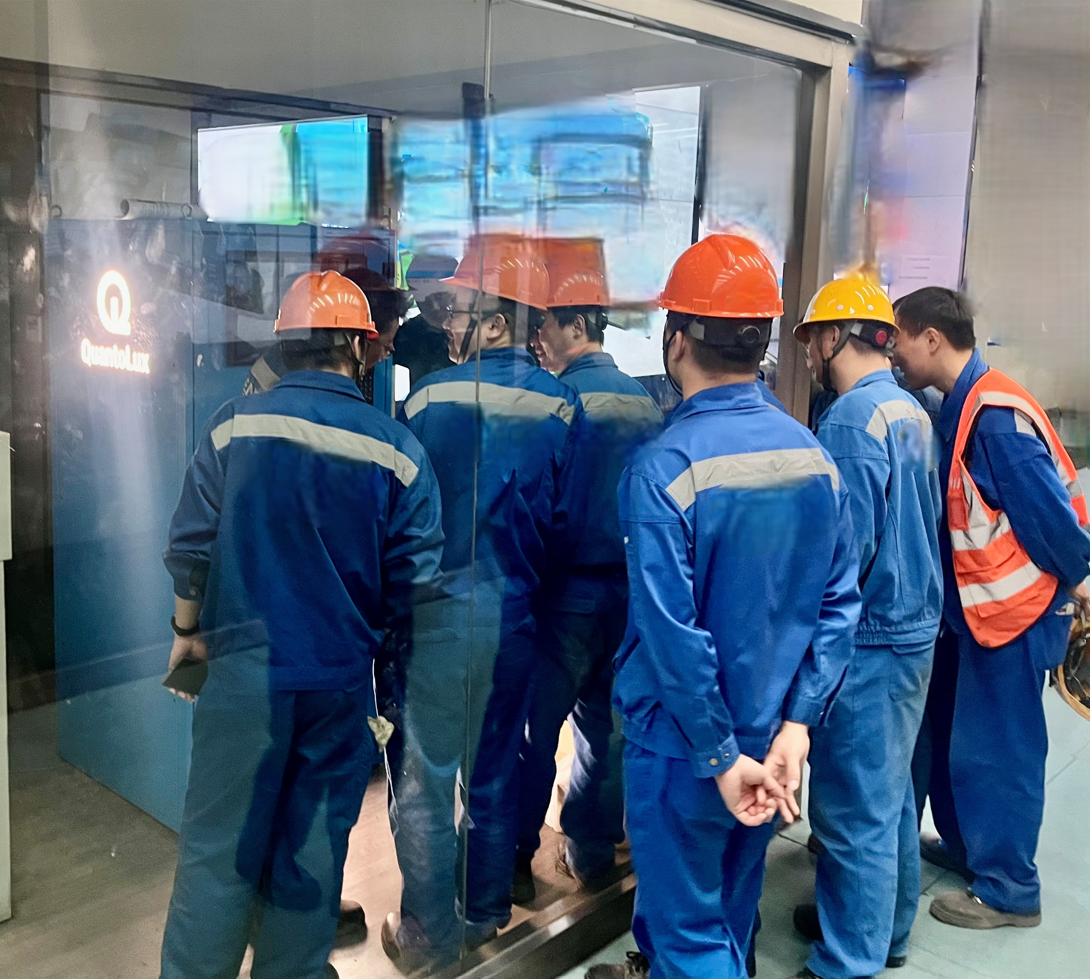
To address this gap, the QuantoLux QLX9 was introduced as a Laser OES (LIBS)-based slag analyzer for fast, at-line operation. The system is installed directly in the melt shop environment, close to the existing Spark-OES setup. This creates a combined analytical infrastructure where both steel and slag compositions are available within a comparable timeframe.
The workflow is simple and designed for operational use: a solid slag sample is taken, placed into the system with minimal preparation, and analyzed within seconds. The system determines elemental composition using laser-induced plasma, covering key process parameters such as FeO, CaO, SiO₂, MgO, Al₂O₃, and MnO.
No complex sample preparation such as crushing, grinding, or fusion is required. Instead, the system uses multi-spot measurements and internal data processing (“digital homogenization”) to handle typical slag heterogeneity. The QLX9 complements existing XRF infrastructure. While XRF remains relevant for reference measurements and specific analytical tasks, Laser OES provides immediate, process-relevant data that enables real-time control.
Results (Measured Impact)
The introduction of fast slag analysis led to clear and measurable improvements in BOF and LF operations:
- Analysis time reduced to seconds
Slag results are now available within seconds instead of typical laboratory turnaround times of 10–30 minutes or more. - Improved BOF end-point control
Real-time FeO and basicity data allow more precise end-point corrections. This reduces reblows and avoids over-oxidation. - More stable process operation
Better process visibility reduces unnecessary or conservative adjustments. - Extended ladle refractory lifetime
Improved slag control, especially regarding MgO saturation and FeO levels, increased ladle lifetime by up to five heats. - Faster-than-expected ROI
Savings from improved yield, reduced refractory consumption, and more efficient operations led to a shorter return on investment than initially calculated.
These results confirm that even small improvements in slag control have a strong economic impact in high-throughput BOF environments.
Operational Impact (Daily Work)
The main operational change is the shift from delayed laboratory feedback to immediate process insight. In the BOF, operators can access slag composition data during or immediately after tapping. This enables more accurate oxygen control and targeted corrections at the end point. In the LF, early knowledge of slag composition allows optimized slag conditioning at the start of treatment. This stabilizes desulfurization and reduces variability between heats.
At the same time, laboratory workload is reduced. Sample preparation effort decreases, and dependency on centralized lab workflows is minimized. The simplicity of the system also reduces maintenance effort and avoids typical downtime associated with complex lab equipment. Overall, daily operations become faster, more stable, and more data-driven.
Strategic Context
Steel production is evolving toward higher quality, higher flexibility, and lower emissions. This development is driven by several factors:
- Increasing demand for advanced steel grades
- Higher variability in raw materials, including scrap and DRI
- Pressure to improve energy efficiency and reduce CO₂ emissions
- Ongoing digitalization of steelmaking processes
In this environment, fast and reliable process data becomes a key enabler. Technologies such as Laser OES allow significantly higher sampling frequencies and provide actionable insights directly at the process. Compared to XRF, Laser OES offers clear advantages in speed and operational simplicity, especially for slag analysis. At the same time, it complements XRF in a combined analytical setup.
The integration of steel and slag analysis into one fast, process-near system reflects a broader trend toward fully data-driven steelmaking.

Conclusion
Real-time slag analysis with QLX9 closes a critical gap between steel and slag process control. It enables more precise BOF operation, more stable LF treatment, and delivers measurable economic benefits within a short time.
Additional Indications of QuantoLux Usage
The described setup reflects a broader trend in advanced steel plants, particularly in China, where steel and slag analysis are increasingly integrated. Public references and industry discussions highlight the growing role of Laser OES as a complementary technology to XRF, enabling fast, process-near slag analysis and improved overall process control.