

In modern steelmaking, fast slag analysis is essential for maintaining quality, controlling costs,...
In modern steelmaking, fast slag analysis is essential for maintaining quality, controlling costs, and optimizing production. Traditional laboratory analyses provide precise results but are often too slow for real-time process control. Today, several fast analysis methods are available, ranging from predictive simulations to direct measurements. This guide sorts these methods by speed, highlighting the advantages and limitations of each.
In short
No single method covers every requirement. For the fastest orientation, predictive simulation delivers near-instant (modeled) values. For direct real-time measurement, OES provides the fastest and most reliable chemical results, ideal for process-near control. For certified reference analysis, the XRF glass bead remains the laboratory standard. In practice the methods complement each other: process-near methods (OES, simulation) for control, established lab methods (XRF) for documentation and round-robin tests, and visual indicators as a low-cost addition.
Why speed matters in slag analysis
- Real-time process control: Fast results let operators adjust furnace parameters immediately, preventing off-spec material.
- Cost efficiency: Reduces downtime and energy waste.
- Quality assurance: Early detection of anomalies ensures repeatable production and consistent steel quality.
Balancing speed, accuracy, and process relevance is crucial when selecting a method.
Fast slag testing methods, sorted by speed
1. Simulation / predictive modeling – the fastest
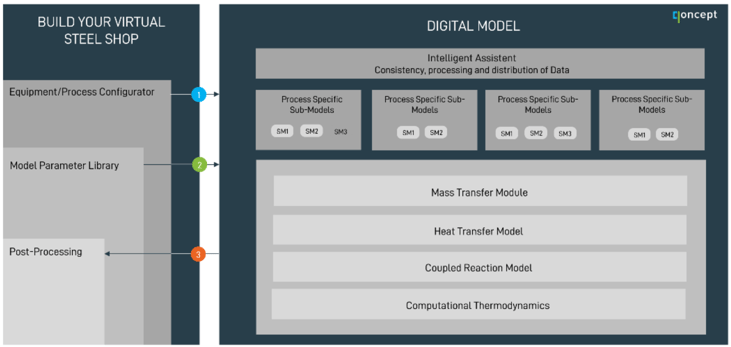
Simulation-based slag analysis uses process data, thermodynamic models, and sometimes machine learning to predict slag composition and behavior in real time. Instead of measuring a physical sample, the method calculates expected slag properties from input materials, furnace conditions, and historical data. This makes simulation the fastest available approach, often delivering results instantly or even ahead of the process. However, it provides indicative values rather than a true chemical measurement and depends strongly on data quality and model accuracy.
Pros: Anticipates trends ahead of time; no sampling required; supports early warning. Cons: Accuracy depends on model and data quality; volatile input materials reduce reliability; gives indication rather than precise elemental analysis.
2. OES (Optical Emission Spectroscopy)
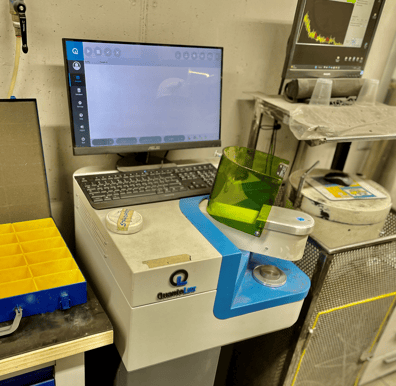
OES is an analytical method in which a focused laser pulse excites a plasma at the sample surface. The emitted light is analyzed to determine the elemental composition. The technique combines high speed with good accuracy and is well suited to process-near or at-line measurements. Results are typically available within seconds, making OES the fastest "true" measurement method for slag analysis. Regular standardization and proper sample handling are required to ensure reliable results.
Pros: Fast; accurate; at-line (close to the process).
Cons: Requires calibration; sampling needed; (so far) not based on certified reference materials (CRMs).
3. EAF/LF arc observation / process observation
Arc observation methods analyze the behavior of the electric arc in an electric arc furnace to draw conclusions about slag condition, such as foaming behavior or viscosity. Cameras, sensors, or electrical signals provide qualitative or semi-quantitative information. The main advantage is speed: no sample is required and information is available in real time. However, the method does not deliver actual chemical composition data and is mainly used as a process indicator rather than a true analytical tool.
Pros: Quick; requires no sampling.
Cons: Qualitative (trend detection); lower accuracy; no reference to actual samples.

4. XRF – pressed pellet
In this method, crushed slag material is pressed into a pellet and analyzed using X-ray fluorescence spectroscopy. XRF pressed-pellet analysis is a robust, well-established technique that delivers reliable results for major oxides. Compared with fused glass bead preparation, the samples are not fully homogenized, making this a compromise between fast results and maximum analytical accuracy. The main limitations arise from sample-preparation time and particle-size effects, which can significantly reduce precision and accuracy for light elements such as Mg, Al, and Si due to XRF's low penetration depth. As a result, this method is commonly used in plant laboratories where a balanced trade-off between speed, accuracy, and cost is required.
Pros: Robust; reliable for the main oxides; traditional and well established.
Cons: Sample preparation required; slower than in-situ methods; less accurate than glass beads, especially for light elements.
5. XRF – glass bead
For glass bead XRF analysis, the slag sample is melted with a flux and cast into a homogeneous glass bead. This eliminates matrix effects and provides very high accuracy and reproducibility. While it is often considered the laboratory reference for slag analysis, it is also the slowest XRF approach due to the melting step. As a result, it is mainly used for quality documentation, calibration, and reference measurements rather than for real-time process control.
Pros: Very precise and reproducible; eliminates matrix effects.
Cons: Longer preparation; not suitable for on-site real-time testing.

6. Visual / optical evaluation
Visual slag evaluation relies on operator experience, assessing slag by color, surface appearance, flow behavior, or foaming. This approach is immediate, requires no equipment, and is widely used in daily operation. However, it is highly subjective and cannot provide quantitative composition data. It is best suited as a quick first indication, often combined with faster analytical or predictive methods.
Pros: Immediate; inexpensive; leverages operator experience. Cons: Subjective; low precision.
Comparison of methods
| Method | Speed | Accuracy | Sample prep | Process proximity | Cost |
|---|---|---|---|---|---|
| Simulation / Predictive Modeling | Extremely high | Medium | None | High | Medium |
| OES | High | High | Low | High | High* |
| Arc observation | High | Low–medium | None | High | Low |
| XRF – pressed pellet | Medium | Medium–high | Medium | Medium | Medium |
| XRF – glass bead | Medium | Very high | High | Low | Medium–high |
| Visual evaluation | Very high | Low | None | High | Very low |
* The cost rating for OES reflects acquisition. In daily operation, OES is cost-effective thanks to minimal maintenance and almost no sample preparation.
Key takeaway: Predictive simulation is the fastest method overall, providing near-instant insights. For direct real-time measurement, OES offers the fastest and most reliable data.
Application examples
- Real-time process control at EAF: Combine simulation and OES for both speed and accuracy.
- Laboratory validation: Use XRF (pressed pellet or glass bead) for documentation and precise elemental analysis.
- Rapid checks: Visual evaluation or arc observation provides a quick qualitative overview.
Frequently asked questions
Which slag analysis method is the fastest? Predictive simulation delivers values almost instantly, but they are modeled. Among direct measurement methods, OES is the fastest true chemical analysis, with results in seconds (full cycle typically under a minute).
Which method is the most accurate? The XRF glass bead is regarded as the reference for the highest accuracy and reproducibility. OES achieves comparable reproducibility for the main oxides in real operation — much faster and with minimal preparation.
Can OES replace XRF? For process-near, real-time control, increasingly yes. For certified documentation and round-robin tests, the XRF glass bead remains the standard. In practice the two are complementary.
Does OES require certified reference materials (CRMs)? So far, usually no — OES slag calibration typically uses secondary/internal reference materials. This suits internal process monitoring well, less so formal standardized reporting.
Why is the XRF pressed pellet less accurate for light elements? Because of particle-size effects and XRF's low penetration depth. Light elements such as Mg, Al, and Si are sensitive to grain size and homogeneity; the glass bead solves this through full homogenization, but at the cost of time.
Conclusion
Choosing the right fast slag analysis method depends on speed, accuracy, and operational context:
- Fastest predictive insight: simulation / modeling
- Fastest direct measurement: OES
- Precise lab analysis: XRF glass bead
- Quick, budget-friendly assessment: visual or arc observation
Combining predictive simulation with fast measurement technologies offers the optimal balance between speed, reliability, and process control, while traditional lab methods continue to ensure documented accuracy.