
Reducing slag analysis time from 15 minutes to just 1 minute can fundamentally change BOF process...
Slag Analysis in Steel Mills: Understanding and Optimizing Processes
Decisions Under Time Pressure
Tuesday, 14:32. A winter morning in a German steel mill. The control room receives a short feedback from the BOF slag sampling: “The slag is too white.”
No further details are available. The deafening noise around the plant makes detailed communication almost impossible. Moreover, a reliable chemical analysis of the slag would take at least ten minutes—if everything goes perfectly.
For the shift supervisor, waiting is not an option. The treatment is ongoing, and the next process step is scheduled. Experienced personnel rely on intuition developed over decades. Based on this, an additional amount of aluminum is added for deoxidation—slightly more than necessary to stay on the safe side.
Whether this was the optimal decision remains uncertain. Perhaps a smaller, larger, or even no addition would have been ideal. The same applies to slight adjustments in treatment duration. The key factor is missing real-time chemical composition data. Decisions under uncertainty are routine in steel mill operations, with subtle but lasting effects on refractory life, alloy consumption, and product quality reproducibility.
Laser-OES: Digital Homogenization Instead of Laborious Sample Prep
The main bottleneck in traditional X-ray fluorescence (XRF) slag analysis is not measurement but sample preparation. Slags are heterogeneous, requiring physical homogenization for reproducible results—crushing, de-metallizing, milling, splitting, pressing, or fusion beads. Each step consumes time, labor, and adds complexity.
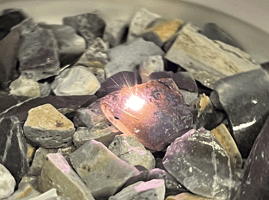
Laser Optical Emission Spectrometry (Laser-OES) takes a fundamentally different approach. Instead of physically homogenizing, it digitally homogenizes the sample. Short, high-energy laser pulses create a micro-plasma on the surface. Thousands of spectra are collected in seconds, then averaged and evaluated by software.
This digital homogenization reduces the influence of local inhomogeneities and allows direct analysis of broken slag without extensive preparation. The classic sample marathon becomes a rapid sample workflow: crush, measure, decide. The analysis moves closer in time and logistics to the process itself.
Case Study: BOF Steel Production – Insights from China
The adage “Make the slag and the steel makes itself” highlights the importance of slag composition. However, evaluating new analysis technologies requires a concrete business case demonstrating measurable impact.
While investments in BOF steel production in Europe are increasingly scrutinized, the situation in Asia—particularly China—is different. Blast furnaces and converters remain central to steel production and will continue to be so. Efficient, robust process monitoring technologies deliver high value here.
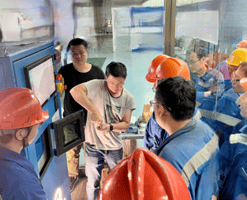
In one Chinese BOF/LF plant, a Laser-OES slag analyzer was installed at-line directly in the process. The goal: capture slag composition in real time, enabling informed decisions for subsequent process steps. In BOF operations, primary slag quality determines whether secondary or tertiary treatments are necessary. Avoiding even a small percentage of additional treatments reduces alloy consumption, process duration, thermal load, and refractory wear.
For example: a 4 million ton steel plant that can cut just 2% of secondary slag treatments translates to 80,000 tons of single-BOF-treated steel annually. At $5 per ton, this equals $400,000 in direct annual savings; at $10, savings double. Secondary benefits—improved process stability, reduced slag composition fluctuations, and more reproducible steel quality—amplify the business impact.
This case demonstrates that fast, process-near slag analysis provides measurable benefits, not just abstract improvements.
Close to the Process: Beyond Preparation-Free Analysis
Besides reduced sample prep, location matters. At-line systems installed near the furnace minimize transport and waiting times, reducing organizational hurdles. Analysis becomes an integral process step rather than an external lab task.
Combined with conventional Spark-OES steel analysis, operators obtain a complete view of steel and slag state. Decisions are no longer based on delayed or anecdotal data but on real-time, correlated measurements, enhancing reproducibility and reducing safety margins in alloy additions.
Reproducibility Insights
A comparison of three methods shows distinct differences:
-
XRF on pressed tablets – high standard deviations (Al₂O₃ 0.65%, SiO₂ 0.93%)
-
Fusion beads – improved precision (Al₂O₃ 0.26%, SiO₂ 0.14%)
-
Laser-OES (QLX) – similar to fusion beads (Al₂O₃ 0.32%, SiO₂ 0.20%)
For MgO—a key element for slag basicity and refractory wear—Laser-OES achieves 0.10% standard deviation, outperforming pressed tablets and rivaling fusion beads.
Laser-OES benefits from multiple measurements on broken material, averaging out inhomogeneities without labor-intensive homogenization, matching or exceeding conventional lab reproducibility.
Our article Practical slag analysis: from crushed material to results. provides more details on the methodological comparison and the importance of sample preparation.
Conclusion
Fast, process-near analysis no longer compromises analytical quality. Laser-OES combines high process proximity with stable reproducibility, comparable to or better than fusion bead and pressed tablet methods.
Speed and analytical reliability now enable informed, timely decisions, expanding classical slag analysis with actionable process information—not replacing lab methods but complementing them for stable processes, consistent quality, and reliable steel production.
The QLX9 laser OES system for granular slag can be widely used in process control for practical slag analysis in steel mills.